Background
Over the course of using conventional trikes (three wheeled recumbent cycles in tadpole layout), I became increasingly aware of their strengths. The main advantage is comfort: a seat instead of a saddle, and a relaxed reclined position instead of leaning forward, which makes long tours noticeably more pleasant.
However, the fun also comes with several drawbacks. Trade-offs, I no longer wanted to accept. That was the point where I began developing a trike that matched my own ideas of perfection. The name of this trike was decided long before it took shape: “Allroadracer.” A machine suitable for any terrain, fast and sporty. It was also meant to be visually appealing, with a clean design and exposed technical elements. A real eye-catcher that inspires speed even while standing still.
Tilting Technology and Seating Position
The first trade-off to solve was the seating position. Conventional trikes have a very low seat height because a higher position raises the center of gravity, forcing the rider to significantly reduce speed in corners to avoid tipping over.
That’s not fun. On the other hand, a higher seat offers a much more comfortable entry and exit, and a better visibility in road traffic.
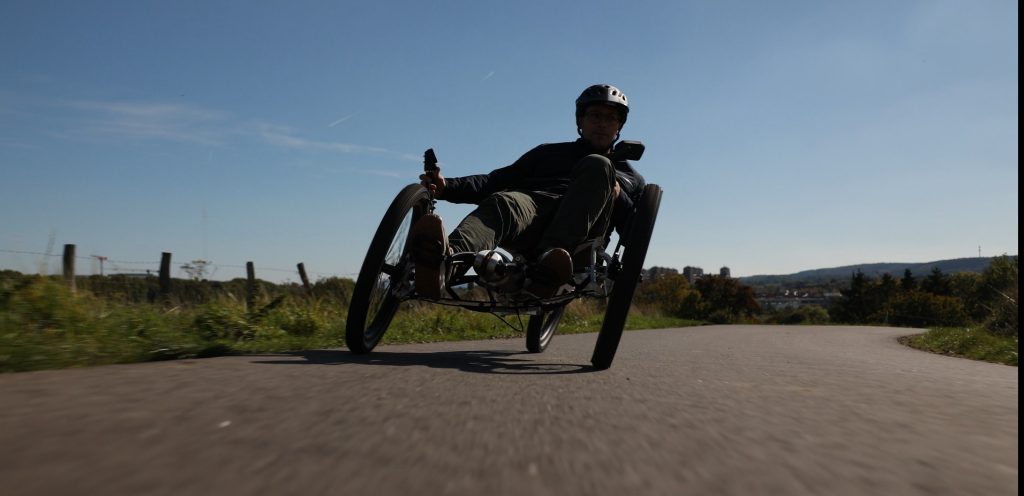
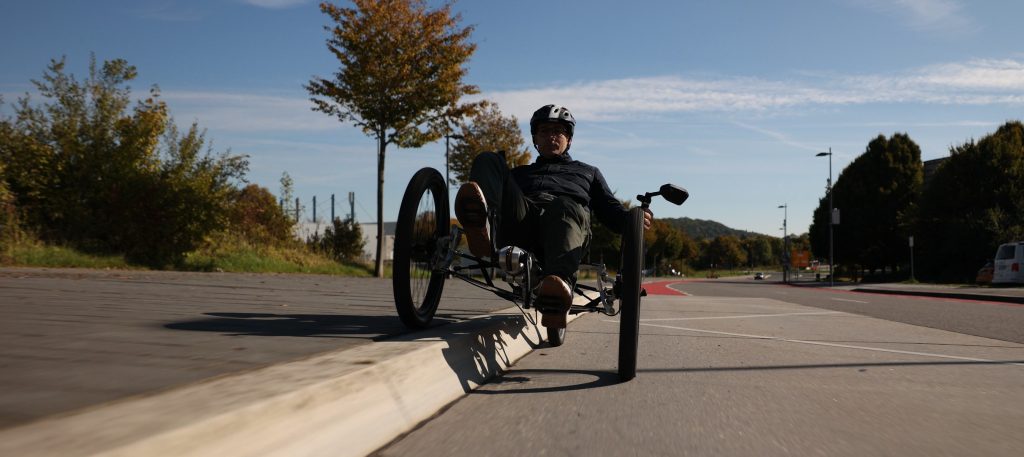
The solution to that trade-off was tilting technology - because once the vehicle can lean into the corner, the height of the center of gravity becomes almost irrelevant. Thus, the Allroadracer was designed to have a high seating position for comfort and visibility, combined with a tilting mechanism that enables fast cornering. A brief research showed that several attempts to build tilting recumbent trikes had been made in the past, and many of them worked. But none survived on the market. Digging deeper into those concepts, my conclusion was that they were often designed too complex which resulted into being not intuitive to control. Also, they lacked features that are considered standard today. Obviously, the Allroadracer was not supposed to suffer from these issues, which led to a series of interesting design challenges.
Control of the Tilting Mechanism
The first task was to develop a tilting mechanism that is intuitive to control - especially at low speeds or when the trike is stationary. Even more challenging is handling stop and go traffic in urban environments.
The problem: tilting systems rely on centrifugal forces, and without speed, there are no centrifugal forces. In the absence of centrifugal forces, another mechanism is needed to stabilize the trike. On a bicycle, you would simply put your foot on the ground or lean against a traffic light to stabilize the bike at standstill. That doesn’t work on a trike due to the seating position.
Common solutions are mechanical tilt locks. They are simple, but operate in a very binary manner and are thus not intuitive. There is no natural transition into centrifugal-force controlled tilting as speed increases - and it becomes unpleasant if you forget to disengage the tilt lock in time. Therefore, tilt locks were not an option for the Allroadracer. Other solutions link steering and tilting through mechanical linkages, enforcing a fixed ratio between steering angle and tilt angle. This is not ideal for real-world riding too. One could use electric actuators to make this coupling variable, adapting it to all speeds. But that requires strong and heavy actuators and sophisticated electronic control, which is expensive and heavy, and therefore unsuitable for a lightweight tilting trike.
A new idea was needed, and it came quickly: both tilting and steering should be controlled using the same handlebar, at any time, completely independent from each other, and suitable for all speeds. In other words, the handlebar can indirectly control the tilt by allowing the rider to use counter steering impulses to generate centrifugal forces - just like on a bicycle. Additionally, the handlebar can directly influence the tilt, being connected via linkages, which is extremely helpful at low speeds or when stationary. The rider can always choose whichever tilt-control method fits the situation. The entire system is implemented using simple kinematics, without actuators and without electronic control. No sooner said than done - and it worked beautifully. The transition between direct tilt control and centrifugal-force based tilt control is completely natural, smooth, and intuitive, as if the transition didn’t exist at all. This is the key innovation of the Allroadracer, now protected by granted patents.
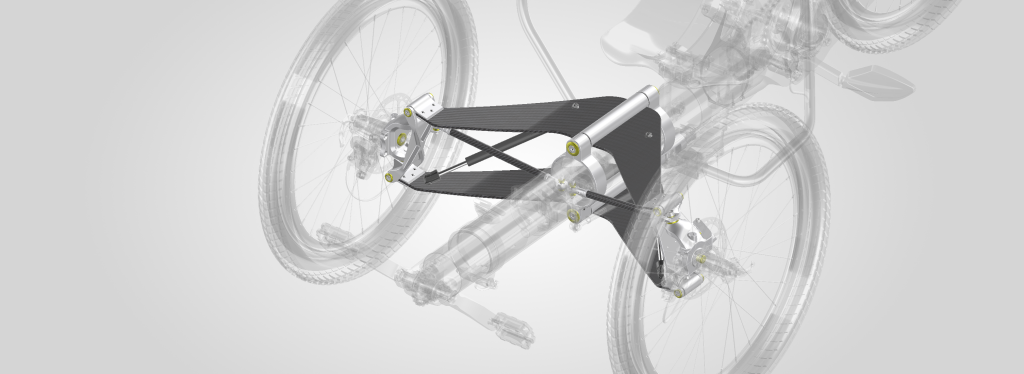
Once the functional principle of the new tilting technology was clear, the exact geometry of the chassis had to be refined. Over the years, I gained extensive experience with double wishbone systems and favor them for both technical and aesthetic reasons, so a double wishbone layout was set. It quickly became clear that this wasn’t easy, because conventional kinematics are unsuitable for the large angular movements required in a tilting vehicle. This began a long phase of chassis design and experimentation until an ideal kinematic solution emerged. For example, steering impulses and braking impulses had to be decoupled across the entire tilt range; otherwise, braking could unintentionally cause tilting - a very unpleasant experience
Frame and Chassis Design
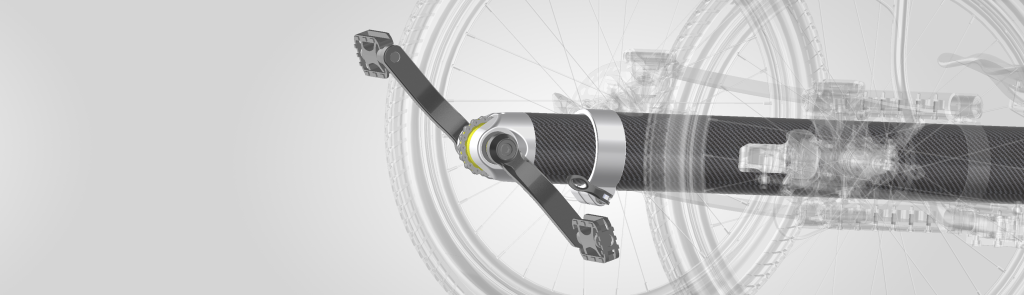
With the functional principle and kinematics defined, the next step was implementation. Since I cannot weld, I often rely on carbon fiber frame construction. It may seem more complex, but if certain principles are followed, it is actually not that complicated - at least from my perspective. Carbon fiber also allows components to be designed either very stiff or very flexible depending on geometry. Thus, the double wishbones of the tilting chassis were made from flexible carbon fiber plates, while the main frame was built from a stiff carbon fiber tube. To maintain a consistent design language, the rear swingarm was designed using the same method. Additional advantages of carbon are its low weight and nice appearance.
Suspension and Rocker-Axle
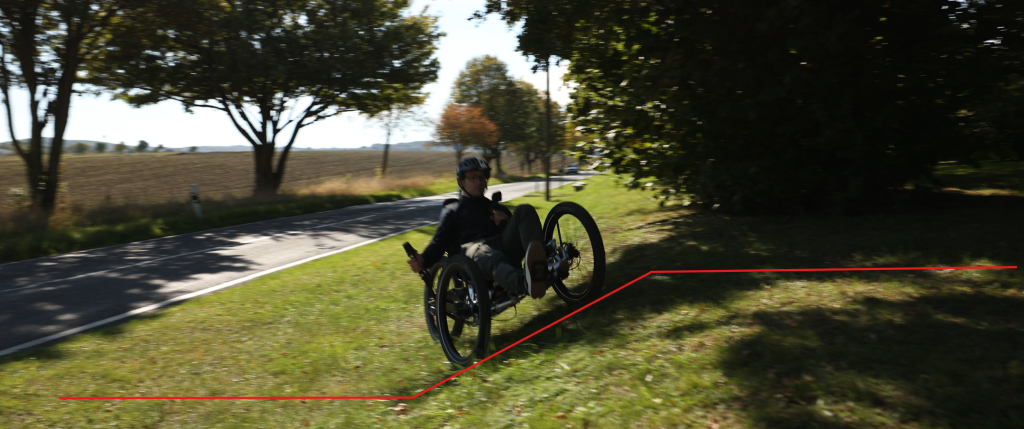
The front suspension is realized through the carbon fiber wishbones, which act as leaf springs. Additionally, hydraulic damping elements are placed between the wishbones to eliminate undesired wheel bounce. The front wheel travel, i.e., the vertical wheel movement, is 70 mm- not particularly high, but not critical for a tilting vehicle. That’s because the tilting chassis also acts as a rocker-axle and can “rock away” single-sided obstacles up to 260 mm. This means tilting vehicles have two types of wheel travel: 70 mm for obstacles affecting both of the front wheels simultaneously, and 260 mm for single-sided obstacles (the far more common case). This enormous wheel travel allows the Allroadracer to conquer extremely rough terrain even at high speed. It also enables riding along steep slopes: the rider remains upright while the rocker-axle tilts according to the slope angle. Such maneuvers are impossible with conventional trikes.
The rear suspension follows conventional design principles. The pivot point of the rear swingarm was chosen so that the Allroadracer achieves an anti rise of about 100%, and the chain line runs very close to the swingarm pivot. This minimizes unwanted cross-effects between suspension movement and pedaling, such as squat and pedal kickback.
Such rear suspension performance is typically achieved in mountain bikes only with four link swingarms. In the Allroadracer, it works with a single pivot swingarm. The reasons are the inherently lower center of gravity compared to a mountain bike and the chain-split between front frame and rear swingarm.
One could say the Allroadracer is downhill capable, without wanting to offend downhill riders. Terminology aside, it is definitely possible to ride rough trails down the hill at high speed. The trail doesn’t even need to be as wide as the front track. Downhill paths with single narrow grooves carved by mountain bikes can be handled easily: One front wheel rides in the groove, the other front wheel rides on the raised edge (as long as there’s no tree in the way) while the rider remains upright.
Drivetrain
A trike is powered like a bicycle, through cranks and a chain. Conventional trikes use a very long chain running along the side of the frame from the cranks to the rear wheel. It quickly became clear that this wouldn’t work here, because a side-running chain would collide with the front chassis, which can occupy many positions due to its large tilt range.
Additionally, I found the side-running chain visually unappealing, especially when a chain length compensation mechanism is needed for adjustable leg length. So it was clear: the chain had to run discreetly inside the frame. Using a large carbon fiber tube as the central frame made this possible, though not easy. The challenge was that all standard bicycle drivetrain components are designed for side-running chains. There were virtually no standard parts that could be used - let alone a standard mid-drive motor suitable for a centered chain. Still, the internal chain was both aesthetically important and technically necessary, and eventually a good solution emerged.
In the front frame section, from the cranks to the rear swingarm pivot, the chain runs inside the frame, including a length compensation system for adjustable leg reach. At the rear swingarm pivot, the centered chain ends, and the drive force is transferred to a side-running chain leading to the rear wheel.
Unfortunately, there are very few gearhubs that reliably shift down while stationary, so the next requirement emerged: there should be an automatic shifting system that ensures the correct gear at every start without needing to think about it. Luckily, there are such automatic systems on the market, so one can choose between: Enviolo AutomatiQ, Rohloff E Shift, 3X3-Automatic, and the interesting newcomer: Revolute A8.
Electrification
Since fast and sporty riding is essential for the Allroadracer, electrification was a no-brainer. A simple rear hub motor was not an option because the rear hub was already occupied by the automatic gearhub. A conventional mid drive motor at the cranks was also not possible because the chain runs centered there, and mid drive motors require a side-running chain. Again, a new solution was needed - without developing a new motor. The performance had to match that of a mid drive motor, meaning the motor must rotate proportionally to cadence, and not to wheel speed. This allows the motor to benefit from the shiftable gearhub, providing a significant performance advantage. A good solution was found: a hub motor mounted in the rear swingarm, ahead of the rear wheel, driving the side-running chain and thus delivering torque before the gearhub. This solution combines two advantages: using a cost-effective hub motor while achieving mid motor performance, all thanx to the way it is installed into the drivetrain.
The battery was mounted behind the seat for easy removal. The position is high and raises the center of gravity, but in tilting vehicles this plays a minor role and is not a real disadvantage.
The next challenge was torque sensing. The system needed a torque sensor to deliver full torque from standstill. The problem: there are no bicycle torque sensors suitable for a centered chain. So, a custom solution was needed here, and eventually found. It is based on industrial torque sensors - cost-effective and readily available.
Chainless Powertrain
While developing the chain-based powertrain, the question repeatedly arose whether a chainless drive would be much simpler. Eliminating the centered chain and its challenges would indeed be appealing. And yes, a chainless system is a viable option: the rider’s pedaling power is converted by a generator into electricity and sent to the motor. The battery adds additional power, and the traction motor drives the vehicle with a multiple of the ridders pedaling input - just like a regular e-bike, but without a chain. This technology is new, but several component suppliers already exist, making a chainless drive feasible for the Allroadracer. In such a case, the absence of the chain would free enough space inside the main frame to place the battery there - removable, of course.
Brake System and Wheel Load Distribution
Conventional trikes usually have a split braking system: one brake lever on the left handlebar controls only the caliper on left front wheel, and the right side brake lever controls only the caliper on the right front wheel. The rear wheel has no driving-brake, sometimes a parking brake. For conventional trikes without tilting and with low seating positions, this makes sense because single-sided braking also helps to steer. As you must brake before cornering anyway to avoid tipping, a one sided brake can steer the trike into the desired direction. Additionally, conventional trikes typically have a weight distribution towards the front wheels, so braking the rear wheel can quickly cause traction loss, making the trike skid uncontrollably. This dangerous phenomenon needed to be suppressed in the Allroadracer. The solution was optimizing wheelbase and weight distribution between front and rear axles, and implementing a braking system where one lever controls the entire front axle and the other lever controls the rear axle - just like on a regular bicycle. This not only increases safety but also enables controlled rear-wheel braking and fun drifting on loose terrain - a must-have for an Allroadracer.